點叫 DimGiu v0.1: never blank on 姨丈 again
If you grew up in a Cantonese family outside Hong Kong, you know the moment: you’re at a banquet, an auntie you half-recognize sits down across from you, and someone hisses the eternal question — 點叫呀? What do I call her? 姨媽? 姑媽? 舅母? Get it wrong and everyone notices. DimGiu (點叫 — literally “what do I call…”) is my attempt to make that moment impossible, and the demo is live with a fictional family you can explore right now.
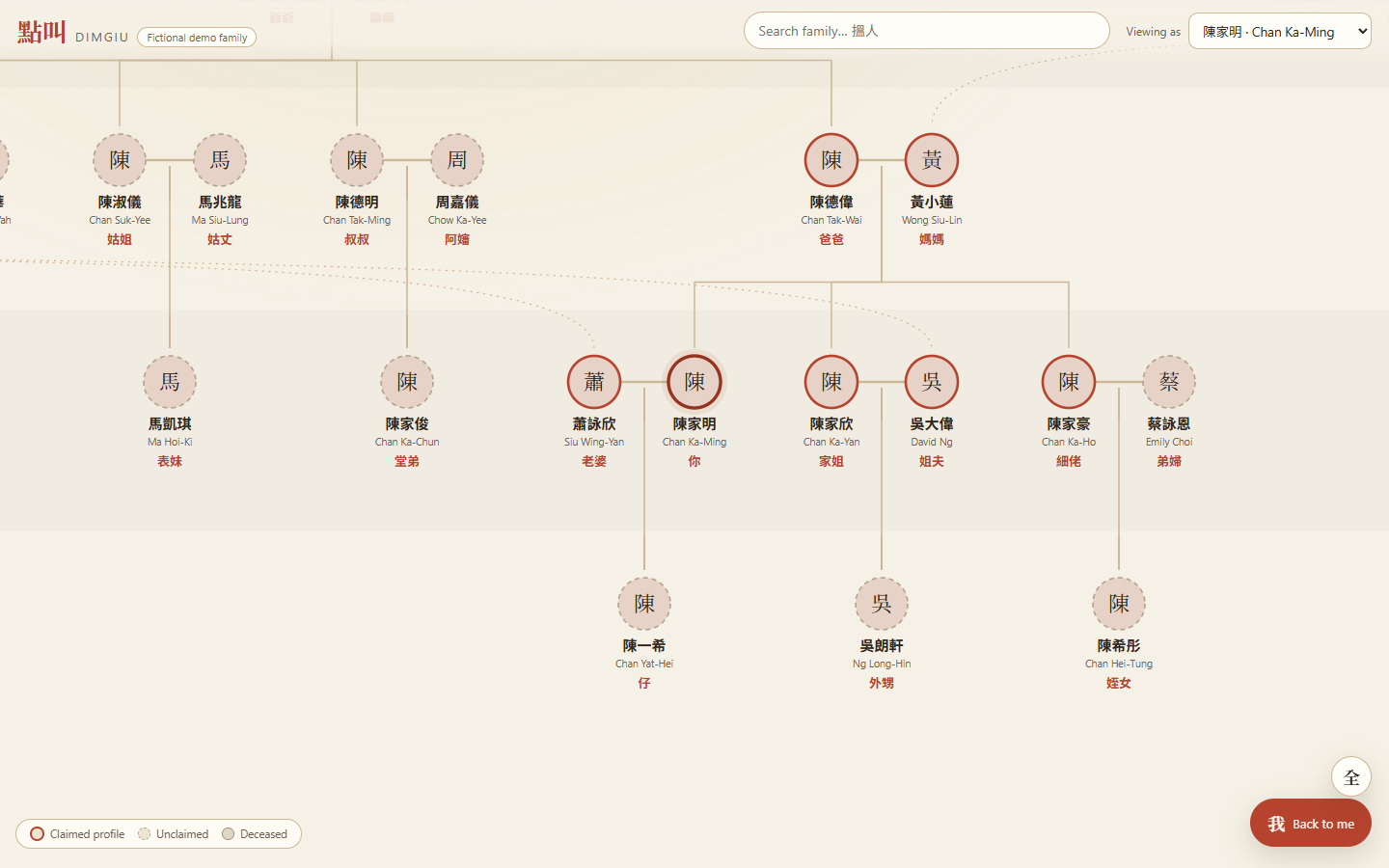
The core trick is that the family tree stores no titles at all — just objective facts: who is whose parent, who married whom, and birth years. Everything else is computed from the viewer’s seat. Pick who you are and the engine walks the graph, works out that this person is your mother’s older sister’s husband, and labels him 姨丈 (ji4 zoeng6) on the map. Switch to viewing as your cousin, and the same man instantly becomes 爸爸. That one interaction — watching every label on the tree flip when you change seats — is the whole product in a nutshell.
The deeper I got, the more the terminology revealed itself as a genuinely elegant formal system. Whether someone is 堂 or 表 depends on an unbroken male line. A generation up appends 公 or 婆 — your dad’s 表哥 is your 表伯, your grandfather’s would be your 表伯公. Descending goes 姪 through brothers and 甥 through sisters — and even the viewer’s own gender matters, because the term mirrors what the child calls you: a man’s sister’s son is his 外甥, a woman’s is her 姨甥. The engine encodes all of that in a couple hundred lines. The map draws faint clan-surname watermarks, threads a red line to show exactly how you’re connected to anyone you tap, and honestly badges any term it derived by rule rather than from the verified table — because every family says things a little differently, and the app should admit what it knows versus what it’s guessing.
Next up: sitting down with the actual authorities — the elders — to verify the term table, a Traditional Chinese UI for the Hong Kong side of the family, and eventually invitations so relatives can claim their own profiles. The dream is that the next kid who freezes at the banquet table just glances at their phone.