Maze TD finds its look: the road to voxel geese
Maze TD is the oldest project in this list that’s never had a build log post — the first commit is from March, before this site existed. The game itself has been mechanically playable for months: A* checkpoint routing, six tower types, overlapping waves, a headless balance simulator that plays out whole campaigns, five campaign maps. What it never had was a look. This month it finally got one, and the road there had enough dead ends that it deserves the full write-up — rejected ideas included.
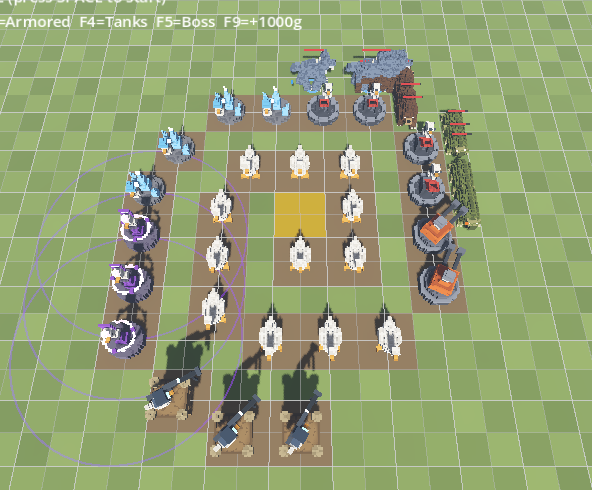
A quick fast-forward through the pre-art era: March was the skeleton — grid, routing, build system, the 3D conversion. July was the big systems push — projectiles, real tower behaviors, the HUD, the balance sim, and a launch roadmap. September added procedural terrain so waves weren’t fought on a literal gray void. Through all of it, the units were primitive shapes and the plan said “art comes later.”
Attempt one: low-poly Blender assets. The first real art pass generated smooth low-poly models through a Blender pipeline — cone trees, beveled turrets, a chunky pink boss. It worked, in the sense that nothing was a sphere anymore. But it had no identity: it looked like every low-poly asset pack ever made, and the pieces didn’t feel like they belonged to the same game. Rejected.
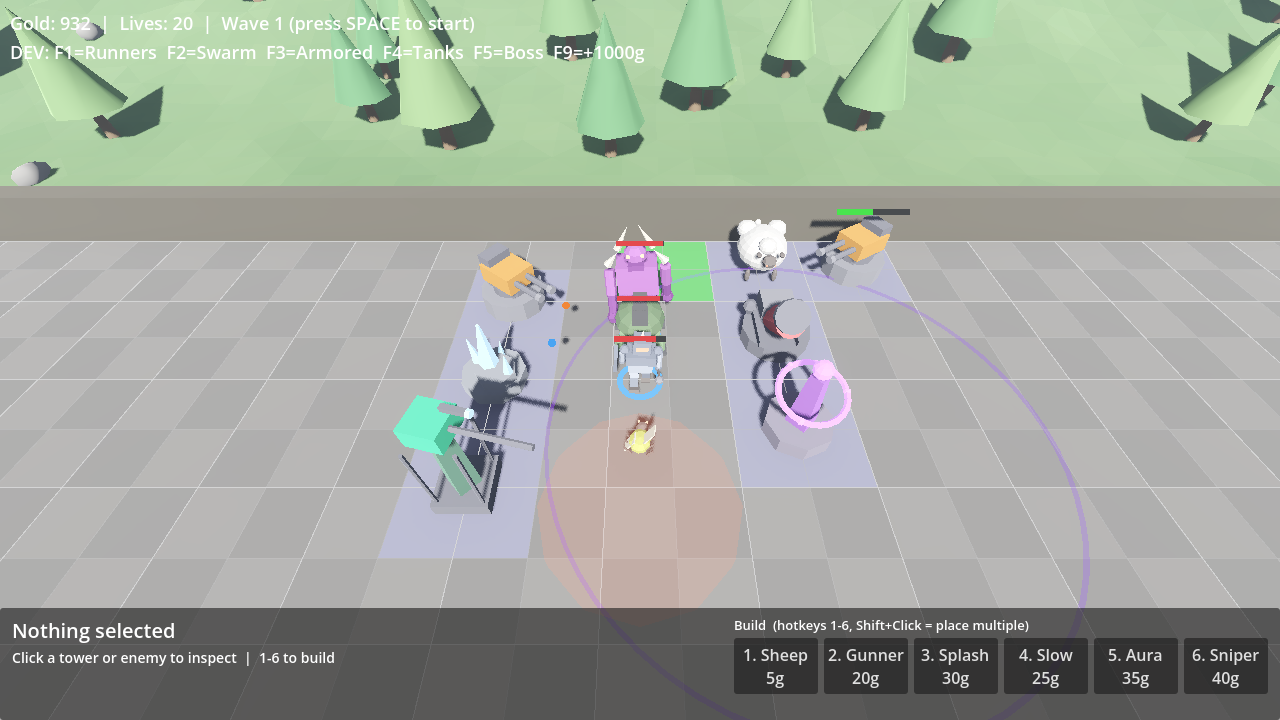
The style decision. The brief I kept coming back to was “WC3 mod, but nicer,” and the shortlist was voxel, painterly Heroes-of-Newerth-style 3D, or 2D like the classic iPhone tower defenses. A voxel proof of concept settled it almost immediately: this is a grid game, so blocky models sit in the world instead of fighting it; silhouettes stay readable at RTS zoom; and the whole pipeline is code — the models are built from a little voxel DSL (with per-color emissive glow for crystal and magic effects), so iterating on a design is editing text, not sculpting.
Attempt two: the armed flock (sheep edition). The WC3 maps this genre descends from famously used sheep as the cheap maze tower, and I’d inherited that. The fun idea that came out of the voxel pass was making the whole defense a flock — not just a sheep wall-block, but sheep crewing every tower: a sheep behind the gunner turret, a sheep sniper kneeling in a sandbag nest. The renders were charming. The problem showed up at gameplay zoom: a sheep is white fluff with a dark face, and the moment a pose or a turret hides the fluff, the silhouette stops reading as a sheep at all. A unit you’ll place forty of per game has to be instantly legible, and this one failed the squint test.
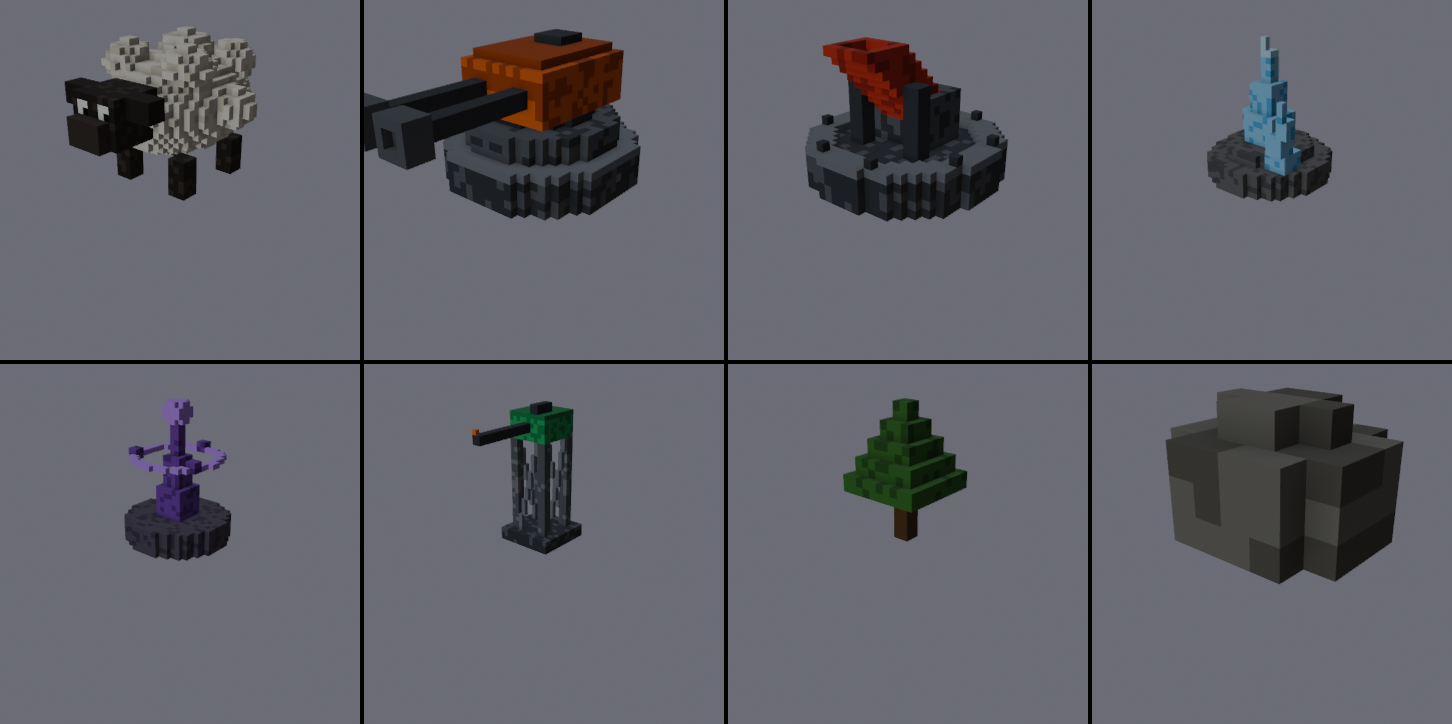
The gaggle. The fix was finding an animal whose silhouette is its identity: a goose. White body, orange bill, orange feet, long neck — readable from any angle at any zoom, and the standing wall goose has unmistakable Untitled Goose Game energy. The sheep were rethemed overnight: the 5-gold maze block is now a Goose, and every tower is crewed by one — a goose manning the cannon, a goose on the sniper rifle, a goose conducting the aura spire. It also retroactively made the whole game make sense, because:
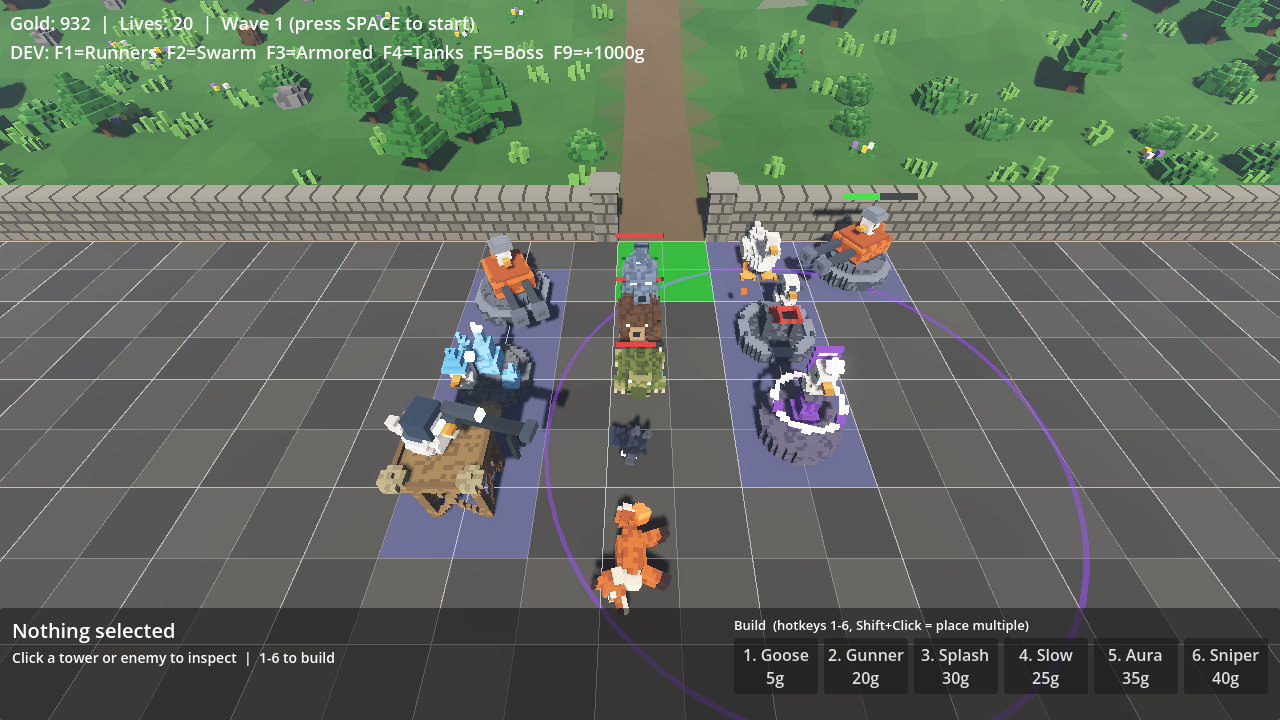
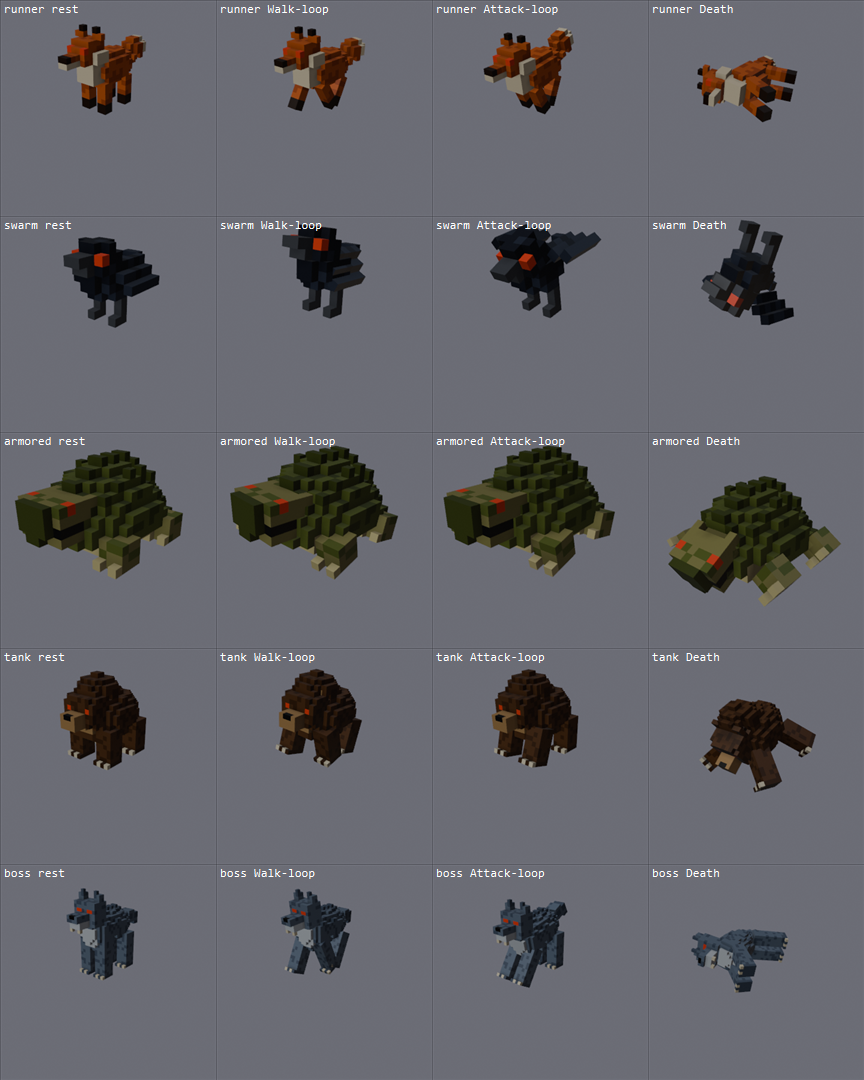
The enemies became predators. Runner, Swarm, Armored, Tank, and Boss were always abstract classes; now they’re a fox, a murder of crows, a snapping turtle, a bear, and a wolf — each with rest, walk, attack, and death poses. The theme now explains the game’s signature rule on sight: there’s no path rejection, so when you wall the route off completely, the predators turn and fight through your geese. Of course they do. They’re predators and it’s a wall of geese.
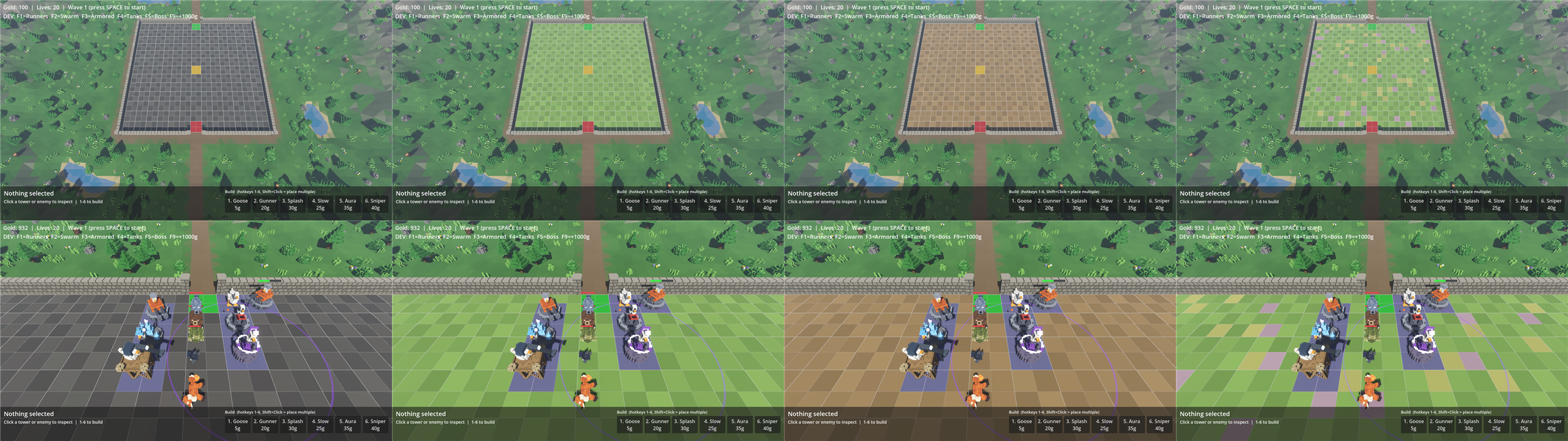
Last stop: the ground itself. With voxel units on it, the flat grey build grid suddenly looked like the placeholder it was. I compared stone, grass, dirt, and a flower-checkered field side by side, and the winner was a mown meadow — it keeps the buildable grid legible while letting the board belong to the voxel forest around it, which got its own pass: trees, rocks, lakes, and a stone wall with a gate where the predators come in.
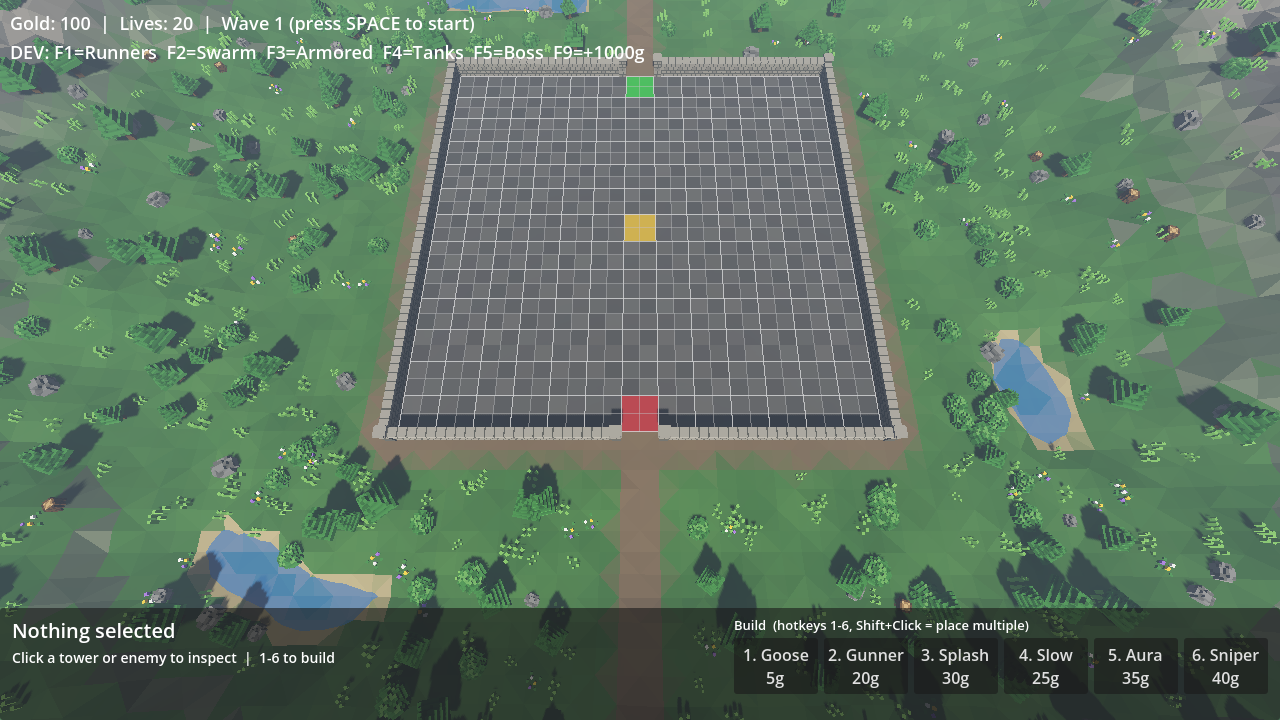
Still a prototype — the debug hotkeys in the screenshots give that away — but for the first time it reads as a game with a point of view instead of a tech demo. Next up: turning the spawn/checkpoint/exit squares into real assets, better camera controls, making armor types and tower tags actually mean something, and onward down the Steam roadmap.